Vision & Mission

The purpose of a Classification Society (“CS”) is to provide classification, statutory certification and services as a Recognised Organisation acting on behalf of a flag Administration, and assistance to the maritime industry and regulatory bodies as regards maritime safety and pollution prevention, based on the accumulation of maritime knowledge and technology.

IACS VISION

To be a trusted partner of regulators with respect to the development of maritime regulations and to maintain classification as the primary mechanism for practical self-regulation of the maritime industry.

IACS MISSION

To establish, review, promote and develop minimum technical requirements in relation to the design, construction, maintenance and survey of ships and other marine related facilities, and,

To assist international regulatory bodies and standard organisations to develop, implement and interpret statutory regulations and industry
standards in ship design, construction and maintenance with a view to improving safety at sea and prevention of marine pollution.

IACS AND ITS MEMBERS’ KEY VALUES
  • LEADERSHIP: the ability to be ahead and co-operate with regulators and industry on initiatives that can effectively promote maritime safety, protection of the environment and sustainability, provide practical real-world guidance to regulators and industry, and appropriately address maritime safety and environmental concerns;
  • TECHNICAL KNOWLEDGE: the collective and individual knowledge and experience gained from the class cycle as shown in figure below to enable the development, adoption and implementation of technical rules and minimum requirements as well as interpretations of statutory instruments, that reflect current practice and changing demands of the society, supporting innovation and new technologies;
  • QUALITY PERFORMANCE: commitment of Members to define and adhere to the highest global quality standards, through rigorous application of the IACS QSCS and through actual performance proved by appropriate key performance indicators;
  • TRANSPARENCY: the ability to openly communicate regarding the concept of class, its vital role and its quality standards, as well as provide advice on the implementation of regulations, interpretations or enhancements thereof, if need is identified, so that practical solutions can be effectively developed in cooperation and with the support of other stakeholders, increasing the trust on class.

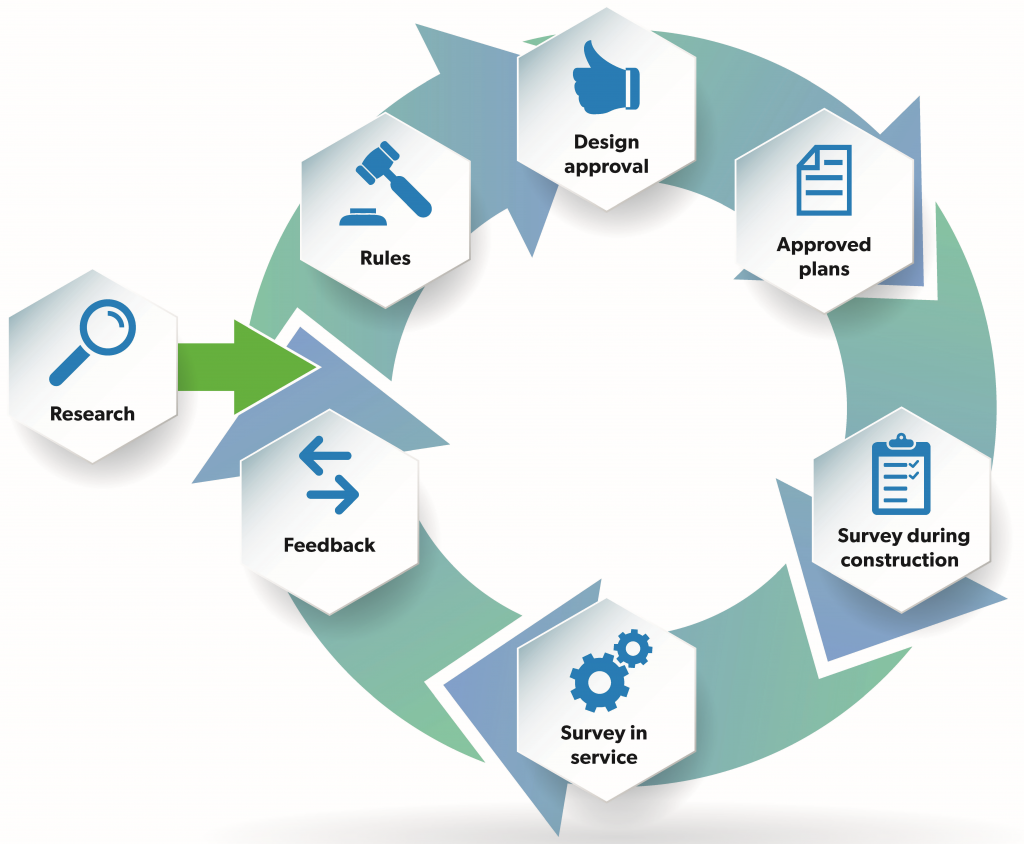
The Class Cycle

IACS MEMBERS’ COMMITMENT

To provide an assurance of professional integrity and the maintenance of high professional standards, by means of:

  • effective application of internal quality management systems complying with the IACS Quality System Certification Scheme (QSCS) and verified by independent Accredited Certification Bodies, and
  • initial assessment and periodical verification of compliance with the IACS Membership Criteria
Position Papers

IACS “Position Papers” are issued and reviewed regularly by IACS on key topics for the Industry. These position papers provide background to the subject matter, IACS position on the subject and summary of actions that IACS has taken.

Please click on the blue text (links) below to view/download the IACS “Position Papers”

Ballast water management

IACS will, within the IMO framework, contribute to developing practical measures and seeking globally consistent implementation of the BWM Convention during the Experience Building Phase that was established to develop improvements to the Convention. IACS also consider that technical challenges with regard to retrofit, engineering, potential safety implications and efficient surveys on-board are to be identified and adequately addressed firstly in IMO instruments or otherwise in IACS resolutions.

Container Ship Safety

IACS shares the concerns raised by marine insurers (IUMI) and the industry regarding the number of incidents/accidents on board container ships, such as cargo fires, fires in engine room, loss of containers at sea, and the influence of whipping on structural design of the container ships. IACS has set “Container Ship Safety” as a new work area and will work with industry stakeholders to investigate the relevant cases for possible improvement of the regulatory framework to mitigate the risks of such incidents/accidents in the future.

Cyber Systems

Cyber incidents on vessels can have a direct and detrimental impact on life, property, and the environment. IACS has steadily increased its focus on the cyber resilience of ships and onboard systems & equipment.

Digitalization

IACS is committed to supporting the maritime industry’s digital transformation, emphasizing the importance of a strategic, safety-oriented approach. The collaboration of expertise and industry engagement can create the foundation of a safer, environmentally conscious, and sustainable future through the development of industry recommendations and regulatory compliance.

GHG emissions from ships

The IMO goal-based regulations are the appropriate means to address GHG reduction measures globally, and IACS will both assist in developing practical detail requirements and implementation of proposed technical and operational measures.

Human Element

IACS is prioritizing the human element in ship safety, security, and environmental protection, while addressing digitalisation and decarbonisation risks throughout a ship’s lifecycle. It aims to develop inherently safer, human-centred designs by incorporating human-focused considerations in the process of developing new IACS instruments.

MASS

The advancement of Maritime Autonomous Surface Ships (MASS) has reinforced future trends of autonomy and the need of improved technical requirements in shipping. IACS intends to contribute to MASS through its involvement in various fora, reinforced by its maritime technical expertise, and as a trusted partner to regulators and industry.

Safety Aspects of New Technologies & Fuels

IACS is working towards identifying and developing new IACS instruments to address the safety aspects related to new technologies and fuels, while referring to available standards, guidelines and common practice in other industries.

IACS will strive to achieve technical solutions that aim to promote inherently safer designs and comply, as appropriate, with the Goals and Functional Requirements stated in the IGF Code.

Underwater Noise Pollution

IACS shares the concern about underwater noise from commercial shipping expressed in MEPC 75/14. IACS has the view that IMO is the appropriate and technically competent body to address the mitigation of underwater noise from commercial shipping globally but is working to harmonize measurement procedures.

Nuclear Propulsion

IACS recognizes nuclear propulsion as an option for decarbonising maritime transport and improving operational efficiency. Leveraging its expertise in maritime, IACS is committed to support the industry ensuring the safe, secure, and environmentally responsible integration of nuclear power into ship design and operations. IACS will contribute to developing robust regulatory frameworks, technical international standards and guidelines through active collaboration with international regulators and industry stakeholders.

Annual Review

IACS, the membership organisation for the world’s leading classification societies, has published its 2024 Annual Review, which highlights the central role played by IACS in supporting safety standards in global shipping.

In a year that marked the 50th anniversary of the adoption of the SOLAS Convention, safety was at the forefront of IACS’s work programme for 2024. This was exemplified by the new Safe Digital Transformation Panel, which began its important work to identify and mitigate any safety risks posed by shipping’s ongoing digital transformation.

Technical and digital advances featured heavily in IACS’s programme for 2024, including the significant challenge posed by new technologies and alternative fuels when it comes to the safety and reliability of engines and other onboard systems. IACS’s work in emerging fields was further highlighted by its work on remote surveys, which included the development of a new Unified Requirement to ensure uniform standards in the conduct of surveys undertaken without the presence of a surveyor.

The report also highlights other areas of important work, including safety standards for gas carriers, improvements to the implementation of the Safe Return to Port (SRtP) scheme for passenger ships, and further guidance to support compliance with ballast water management system (BWMS) standards. 2024 also saw extensive consultation with industry and Flag States on the ongoing comprehensive review of the IACS Common Structural Rules, which will continue into 2025 and until their expected adoption in four years’ time.

Although digital and technological innovation has been a core focus of IACS’s work, the human element has remained at the heart of IACS safety agenda. As the report explores, IACS has continued to invest heavily in training and guidelines that support the role of people, including the risks posed to and by people in a ship’s lifecycle.

Quality Commitment

Guiding Principle

Quality is one of the 4 pillars of IACS and the IACS Quality System Certification Scheme (QSCS) is designed to achieve demonstrable, high quality performance of IACS Members.

IACS promotes continual improvement of its Members’ performance in the pursuit of high levels of safety of life, property and protection of the maritime environment.

IACS encourages and supports its Members to deliver:

  • high levels of technical expertise and competence;
  • integrity, impartiality and ethical practices; and
  • excellence of services either acting as a Classification Society or as a Recognized Organization.

In endeavouring to achieve the above objectives, IACS Members’ individual quality management systems, which inter alia are established in compliance with IACS QSCS, are independently audited by Accredited Certification Bodies (ACBs).

QSCS is continually reviewed and maintained by the Quality Committee with the advice of the Quality Advisory Committee, which is comprised of independent senior industry figures who provide advice and input from the perspective of parties external to IACS and its membership, interested in the quality management of classification and statutory services and the effectiveness of the QSCS.

IACS Members’ commitment

To provide an assurance of professional integrity and the maintenance of high professional standards, by means of:

  • effective application of quality management systems complying with the IACS QSCS and audited by independent ACBs,
  • initial and periodical verification of compliance with the IACS Membership Criteria.
Quality Commitment 1 – Selection of ACBs

IACS Members shall select one of the ACBs that satisfies the requirements of the QSCS to conduct the audits and confirm compliance with the IACS Quality Management System Requirements (QMSR).

Quality Commitment 2 – Integrity of the audits

IACS Members shall ensure QSCS audits are conducted with full openness and cooperation with the ACB and the Quality Secretary shall ensure the continued robustness, consistency and integrity of the scheme.

Quality Commitment 3 – Recognition of the inherent value of effective audits

IACS Members recognise that QSCS audits improve their individual quality management systems and processes and facilitate continuous improvement at all levels.

Quality Commitment 4 – Issuance of findings

IACS Members are entitled to challenge and question the ACB, however they shall respect that the final authority to issue any independent finding rests with the ACB.

Quality Commitment 5 – IACS Council commitment to quality matters

Quality is one of the pillars of IACS and IACS Council shall deliberate quality related matters in every Council meeting. Further, the Quality Committee Chairman and Quality Secretary shall have direct access to Council in matters related to quality.

FAQs

  1. Why is Quality so important to IACS?
    The entry into force of the IMO Member State Audit Scheme in January 2016 (SOLAS Chapter XIII, MSC.366(93)), adoption of the IMO Instruments Implementation Code (III Code, A.1070(28)) and the Code for Recognized Organizations (RO Code, MSC.349(92), MEPC.237(65)) clearly demonstrate how critically important the shipping industry as a whole, views Quality in realising high standards for safety, pollution prevention and operational aspects of ships.
  2. What is IACS Quality System Certification Scheme (QSCS)?
    IACS QSCS is the audit and certification scheme developed and adopted by IACS in 1991. It comprises a set of IACS requirements based on the latest versions of internationally recognised quality standards (i.e. ISO 9001 and ISO-IEC 17020), IMO Resolution MSC.349(92) and MEPC.237(65) (RO Code) and IACS Resolutions. The first IACS QSCS certificates were issued to IACS Member classification societies in 1993. The Scheme remains a cornerstone of IACS membership.
  3. How does IACS maintain its lead in quality management for the industry?
    The development, maintenance and continuous improvement of QSCS during the previous 26 years, represents a significant effort by IACS and its members.  QSCS embraces the entire ‘class cycle’ of rule development, design approval, survey during construction, survey during service, research and development and feedback gained from experience in the practical implementation of rules and regulations as well as industry feedback. QSCS, the industry ‘Gold Standard’, remains a powerful and relevant tool – and IACS remains committed to ensuring that it meets the needs of its members and interested parties.
  4. How is IACS Member compliance with IACS QSCS assured?
    Each IACS Member is subject to annual audits against the requirements of ISO 9001 and IACS QSCS by an independent Accredited Certification Body (ACB)*. Provided the result of the audits are satisfactory, the ACB issues or endorses the Member’s ISO 9001 certificate. In addition, the ACB furnishes each IACS member annually with a Statement of Compliance, demonstrating the requirements of IACS QSCS (and consequently the IMO RO Code) have been satisfied.*An ACB is an organisation, wholly independent of IACS and IACS members, accredited to comply with ISO/IEC 17021 standard by an accreditation body who is signatory to the International Accreditation Forum (IAF) Multinational Recognition Agreement (MLA).  Auditors used by ACBs for IACS member audits to IACS QSCS are competent in the work of classification societies and knowledgeable of the maritime sector in general.
  5. What does IACS Operations Centre do?
    IACS Operations Centre (OC) oversees the effective administration and operation of the QSCS, ensuring the continued robustness, consistency and integrity of the scheme, with a uniformly high quality standard within IACS.Each year OC observes a selection of the ACB audits, and provides refresher course for ACB auditors to maintain and update their knowledge regarding class and statutory requirements and other relevant industry initiatives.
  6. How does the IMO oversee IACS QSCS and its implementation?
    Since QSCS was established in the early 90’s IMO has had an observer dedicated to the scheme to oversee and report annually on its evolution and development to the IMO Maritime Safety Committee.  That arrangement continues to this day, whereby the observer selects several audits he will attend every year, in addition to holding regular meetings with IACS Quality Secretary and attendance at IACS Quality Committee and Advisory Committee meetings.
  7. Where can I find out more information about IACS QSCS?
    If you would like more information about IACS QSCS email us at qscs.ops@iacs.org.uk

IACS QSCS

IACS Quality System Certification Scheme (QSCS) is the management system IACS member classification societies developed and put in place during the early 90’s. Compliance with QSCS has since always been required for IACS members and that requirement continues to the present day.

The scheme itself has however continually evolved and developed, and the drive to make the scheme the best it can be continues unabated. Today, and after 25 years plus of evolution, QSCS is widely recognised as the ‘gold standard’ for classification societies.

The principle objective of QSCS, which contains the procedures, processes and practices of the scheme, is to verify that every classification society obliged to comply with QSCS has developed its own internal quality management system, satisfying the requirements set out in IACS Quality Management System Requirements (IQMSR) – now on its 10th issue. IQMSR is an integral part of the QSCS.

IQMSR is the management standard against which the classification society is audited. It is based on ISO 9001:2015, supplemented by specific requirements that characterise and are relevant to the work of classification societies. The audits of IACS members, and those classification societies considering applying for membership of IACS, are conducted by independent accredited certification bodies (ACBs) that must also meet clear, transparent criteria to ensure the audits are conducted to a robust standard, consistent across the IACS members and applicants.

A list of the ACBs currently verified by IACS as compliant with the requirements described in QSCS and used by IACS members, as well as IACS Procedures Volume 3, which contains all details of IACS QSCS.

End User Workshop (EUW)

The 2025 EUW was held at the Harbour Grand Hotel, Hong Kong over 1.5 days, Tuesday 18th and the morning of Wednesday 19th November 2025.

When IACS decided, in 2008/9, its members would be audited against IACS Quality Management System Requirements (IQMSR) by independent accredited certification bodies (ACBs), as opposed to the hitherto in-house audit team, it recognised that honest and open feedback on the new arrangements would be vital in ensuring IACS QSCS remains valid, fit for purpose and effective.

To that end and in November every year since 2009, IACS has arranged an annual End User Workshop (EUW).  This annual event brings together all the key stakeholders of the Scheme and other organisations that have an interest in IACS QSCS.  Attendees typically comprise all IACS members, all ACBs that audit IACS members, flag Administrations, the European Commission, the European Maritime Safety Agency (EMSA), QACE, non-IACS classification societies that are interested in adopting QSCS either voluntarily or with a view to applying for membership of IACS and ACBs that may be interested in auditing against IQMSR.

As an impartial yet knowledgeable facilitator, the EUW is chaired by the Advisory Committee Chair.  The format of the workshops is designed to promote free and open discussion with a view to maintaining the robustness, integrity and consistency of the scheme.  To promote discussion, stakeholders are given the freedom to feedback and reflect on their experiences of working in or with the scheme and to propose and discuss any possible adjustments deemed appropriate to ensure QSCS continues to meet fully the demands and needs of all stakeholders for a robust and consistent scheme that is now widely recognised within the shipping industry as the ‘gold standard’ for classification societies and certification of IACS members.

Without exception all EUWs have proved to be positive events.  All participants actively and constructively contribute which has and continues to have, a tangible and meaningful influence on the evolution of IACS QSCS ensuring the Scheme continues to be relevant, up-to-date and meets the needs of all interested parties and stakeholders.

Those organisations or individuals that have a clear interest in IACS QSCS and would like to attend future EUWs, should contact IACS Quality Secretary, Jonathan Spremulli at qscs.ops@iacs.org.uk

Advisory Committee (AVC)

The purpose of this long established IACS committee is to advise the IACS Quality Committee on the effectiveness of IACS Quality Systems Certification Scheme (QSCS) and its further evolution and improvement.

IACS, as an association, was formed in 1968 to promote high standards of safety and pollution prevention in the maritime industry.   IACS members have never wavered from that objective and in pursuit of ever higher standards of service, in 1991 established the QSCS.  This is the management system that ensures the internal quality management system of each individual IACS member conforms to the requirements of the IACS scheme which is freely available on the IACS web site.  QSCS, widely recognized as the ‘gold standard’ for classification societies, is continually reviewed and updated by IACS and provides an all embracing, structured framework that all IACS members must comply with.

The AVC represents the interests of external stakeholders that have an interest in the services provided by IACS member classification societies within the scope of the QSCS.  This also includes inspections and surveys carried out by the classification society when recognized by the Administration for statutory certification and services work.

Comprised of senior industry figures that have a deep knowledge and understanding of the work of classification societies and the principles of quality management.  The committee meets twice a year and actively contributes to its improvement by providing independent counsel regarding the proper and impartial application of QSCS and ensures no single interest predominates in the decision making process.  Individual members of the AVC are personally appointed to the committee by IACS Council.  In undertaking it’s work the AVC reviews the results of audits, complaints and other relevant information appropriate to the proper functioning of the QSCS.

Taking an impartial view of the work and performance of IACS members, where the AVC considers it appropriate, it will make recommendations to IACS as to what improvements it considers could be made to enhance the policies and working methods regarding the operation of QSCS.  This includes scrutiny of the standard of audit conducted by the independent Accredited Certification Bodies (ACBs) recognised by IACS Members.

In addition to members of the AVC attending at least two audits per year, the Chair of the AVC  submits an annual report to the IACS summer Council meeting, which he also attends for quality matters, when the Quality Secretary presents the annual quality management review.

IACS GPG Chairman, Quality Committee Chairman and Quality Secretary are all ex-officio members of the AVC.  The current membership of the AVC is as follows: