
PRESS RELEASE 8 JANUARY 2015

Robert will join from the Cruise Line International Association where he is Secretary General.

He will formally take over from Derek Hodgson who retires as Permanent Secretary of IACS at the end of June 2015.

For more information contact:
Derek Hodgson
Permanent Secretary
+44 20 7976 0660
derekhodgson@iacs.org.uk

IACS SEEKS NEW QUALITY SECRETARY

The International Association of Classification Societies (IACS) is a not-for-profit membership organisation of classification societies that establishes minimum technical standards and requirements that address maritime safety and environmental protection and ensures their consistent application.  It carries out this responsibility through its panels, expert groups and project teams and provides a Quality System Certification Scheme (QSCS) that its Members comply with, as an assurance of professional integrity and maintenance of high professional standards (see www.iacs.org.uk/quality/).

The IACS’ Quality Secretary is retiring after seventeen successful years, with effect from May 2022.  We are now searching for a successor to start in Q1 of next year, with a view to taking over as the IACS Quality Secretary in May.

The IACS Quality Secretary’s main purpose is to promote the effective operation of the Quality System Certification Scheme (QSCS), ensuring the continued robustness, consistency and integrity of the scheme, with a uniformly high-quality standard within IACS.

The role of the Quality Secretary is vital for the effective monitoring of the Association’s members’, and their Accredited Certification Bodies’ compliance with the QSCS. It requires energy and sustained commitment.  It is a role which requires a positive outlook, the strength of character to communicate clearly with colleagues, peers and senior managers and an ability to make sound judgements in fast-moving and multi-faceted environments.

The role is UK focused and requires frequent travel both internationally and to London.

For a copy of the candidate brief please email IACS in confidence at recruitment@iacs.org.uk.  If you would like a discussion about the role with IACS’ Secretary General, Robert Ashdown, please indicate this when requesting the brief.

Only those candidates selected for interview will receive a response.

The deadline for applications is Friday, 26th November.

IACS COUNCIL MAKES SUPPORTING SAFE MARITIME DECARBONISATION A MAIN OBJECTIVE

The 84th session of the IACS Council has highlighted the significant safety challenges around decarbonisation. The centrality of the human element in increasingly technically sophisticated vessels and the importance of maintaining IACS’ Quality Scheme as a guarantor of its members’ demonstrable, high-quality performance were other focus areas.

Meeting again by videoconference due to the restrictions of the Omicron variant, C84 was chaired by Nick Brown, CEO of Lloyd’s Register and comes shortly after COP26 and IMO’s MEPC 77.

Noting the markedly increased expectations for an ambitious and accelerated greenhouse gas (GHG) reduction policy for shipping, IACS Council emphasised that the successful delivery of any agreed targets must recognise the need for a practical and achievable implementation plan.

Building on its submission to IMO’s Assembly (A 32/12/2) C84 discussed ways in which introducing the necessary alternative technologies and fuels must not happen without detailed safety requirements that support the design, fabrication and integration of equipment for systems and ships.

C84 recognised that the unique, multi-disciplinary nature of the challenge, its scale and compressed timeframes for delivery, and the lack of extant technical solutions to achieve the desired outcomes, warranted a dedicated and bespoke response. Accordingly, IACS Council agreed to hold an extraordinary Council meeting early in 2022 solely to give more time for agreeing structured and ambitious IACS actions to address decarbonisation.

Promoting the safety considerations that will accompany the use of new technologies and fuels was widely welcomed by the industry session that followed C84. There was unanimous support for establishing an effective assurance arrangement for the safety of decarbonisation solutions, with IACS’ unique ability to develop common technical requirements viewed as being a key contributor for delivering regulatory certainty.

Given the take up of new technology, C84 also focused on the role of the seafarer in this newly digitalised world and the changing nature of technology on board ships. IACS has long recognised the need to consider ships as complex systems, and systems of systems, and C84 initiated work on the dependency on the human component in those systems for safe operations.

On quality matters, C84 noted that IACS Quality System Certification Scheme (QSCS) remains the ‘gold standard’ for classification society performance but that, in the 30 years since its inception, many other quality driven initiatives had been established, complicating the overall picture. C84 therefore established a high-level working group, to include representation from its external and independent Quality Advisory Committee, to conduct a holistic overview of IACS Quality provisions with the objective of rationalising and enhancing quality oversight as part of IACS’ unceasing commitment to continuous improvement in this area.

C84 also marked six months of IACS’ new governance structures which have quickly increased the agility and responsiveness of the Association. Noting the additional demands this makes of the Association, Council Members reaffirmed their commitment to supporting IACS by further strengthening the new Technical Team based in the IACS Secretariat thus enhancing the ability to conduct at speed detailed technical discussions with the IMO and industry associations.

Owing to the continuing uncertainty caused by the pandemic, C84 also renewed the mandate of its COVID 19 Task Force noting that the swift and decisive actions of this group have been instrumental in developing and adopting measures that help ships safely remain in service and in compliance with Class Rules and the requirements of the international Conventions.

Speaking after the meeting, Nick Brown said ‘The wide-ranging discussions and agreements reached at C84 demonstrate clearly the key role that IACS plays in supporting the industry address complex challenges, many of which require sustained commitment and new ways of working. The new governance changes are demonstrating their effectiveness in helping deliver practical and implementable solutions.’

Contact:
Robert Ashdown, IACS Secretary General
E: robertashdown@iacs.org.uk T: +44 (0) 20 7976 0660
International Association of Classification Societies
Permanent Secretariat 4 Matthew Parker Street, London, England SW1H 9NP
E: permsec@iacs.org.uk
T: +44 (0)20 7976 0660

IACS PARTICIPATION AT MEPC 77

Noting the work IACS Members undertake as Recognized Organizations of IMO Member States, verifying compliance of ships with IMO agreed requirements, and with a view to achieve clarity for all parties, IACS has submitted and co-sponsored the following papers:

MEPC 77/4/6 proposes a draft unified interpretation of regulations E-1.1.1 and E-1.1.5 of the International Convention for the Control and Management of Shipsʹ Ballast Water and Sediments, 2004 to clarify the timing for mandatory implementation of commissioning testing of individual ballast water management systems in accordance with resolution MEPC.325(75) and taking into account BWM.2/Circ.70/Rev.1.

MEPC 77/4/7 provides information on the status of the experience-building phase (EBP) associated with the Ballast Water Management (BWM) Convention, and proposes to extend the EBP in order to provide sufficient time for the various stages of the EBP to be effective and ensure follow-up decisions relating to a review of the BWM Convention are meaningful and based on sufficient feedback and data

MEPC 77/4/11 proposes a unified interpretation of regulation B-3.10 of the International Convention for the Control and Management of Ships’ Ballast Water and Sediments, 2004 concerning the deadline for compliance with the D-2 standard for ships constructed before 8 September 2017 but which do not have completed an initial survey associated with the IOPP certificate until after 8 September 2019.

MEPC 77/7/7 proposes a draft unified interpretation of regulation 18.3 of MARPOL Annex VI, related to the use of biofuels. IACS request confirmation that ISO 8217:2010, 2012 or 2017 standards are also acceptable fuel specifications to be used at the parents’ engine NOx emission test and can be used despite the NOx Technical Code only referring to ISO 8217:2005 standard. IACS also seeks the Committees direction for amendments to MARPOL ANNEX VI and the NOx Technical Code to provide a long-term solution to the issues with the application of MARPOL Annex VI and the NOx Technical Code with respect to the use of biofuels.

MEPC 77/7/26 comments on document MEPC 77/7/2 (Japan et al.) containing the draft amendments to the EEXI calculation guidelines and associated guidance to incorporate the in-service measurement method. IACS proposals are contained in paragraphs 6 to 9 of the paper.

MEPC 77/11 proposes a new output to develop amendments to the 2014 Standard specification for shipboard incinerators (resolution MEPC.244(66)) by revising the provisions of its annex 2 on fire protection requirements for incinerators and waste stowage spaces, to remove the discrepancies between resolution MEPC.244(66) and SOLAS chapter II-2.

MEPC 77/11/1 proposes to extend the scope of the existing output 2.15 to address test cycles and related amendments of the NOX Technical Code 2008.

MEPC 77/11/2 proposes a revision of the 2017 Guidelines addressing additional aspects of the NOX Technical Code 2008 with regard to particular requirements related to marine diesel engines fitted with Selective Catalytic Reduction (SCR) systems (resolution MEPC.291(71) as amended by resolution MEPC.313(74)) (the 2017 SCR Guidelines, as amended) to improve their clarity and enable a uniform implementation.

IACS will also provide advice and comments to the Committee under agenda item 5 (Air Pollution Prevention), agenda item 6 (Energy Efficiency of Ships), and agenda item 14 (Any Other Business).

Any enquiries on the above should be sent to Konstantin Petrov, IACS Accredited Representative to IMO, at arimo@iacs.org.uk
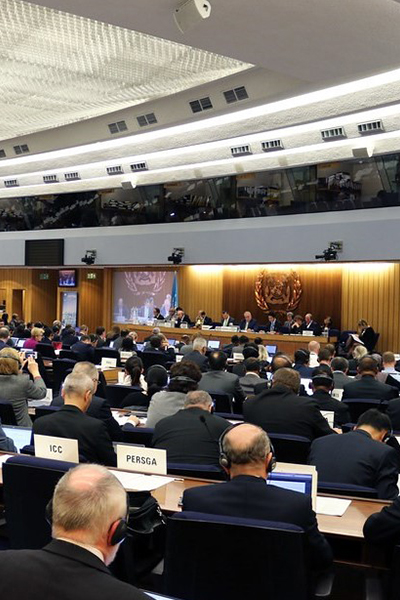
IACS PARTICIPATION AT SDC 8

Noting the work IACS Members undertake as Recognized Organizations of IMO Member States, verifying compliance of ships with the IMO agreed requirements, and with a view to achieve clarity for all parties, IACS has submitted or co-sponsored the following papers:

SDC 8/4/2 proposes changes to the draft new SOLAS chapter XV and the IP Code and seeks clarification on aspects related to IP Code certification.

SDC 8/4/4 provides comments on the modifications to the text of paragraph 8.4 of the draft IP Code as agreed by PPR 8.

SDC 8/6/2 proposes draft amendments to the 2011 ESP Code regarding applicability to oil tankers carrying oil in independent tanks not part of ship’s hull, tank testing of ballast holds of bulk carriers and examination of ballast tanks at annual surveys, for consistent implementation of the requirements.

SDC 8/10 seeks the view of the Sub-Committee to clarify whether an operational assessment, as required by paragraph 1.5 of part I-A of the Polar Code, can be used to exempt or reduce the equipment requirements in the Polar Code.  IACS is of the view that the lack of clarity on this matter has a potential to cause inconsistent application of the Polar Code.

SDC 8/10/1 proposes a unified interpretation of regulations 4.3.1 and 4.3.2 of part 1-A of the Polar Code to clarify the requirements for the ice accretion and its application for the intact and damage stability calculations.

SDC 8/10/2 proposes a draft unified interpretation of regulation 37(3) of the Protocol of 1988 relating to the International Convention on Load Lines, 1966 (hereinafter referred to as the 1988 Load Lines Protocol), as amended, with a view to its global and consistent implementation.

SDC 8/10/3 proposes a new draft unified interpretation on the amendment to stability/loading information in conjunction with the alterations of lightweight, for the effective application of SOLAS regulations II-1/5.4 and II-1/5.5.

SDC 8/10/4 discusses the application of the individual paragraphs of SOLAS regulation II-1/17-1 to internal and external doors, at or above the bulkhead deck on ro-ro passenger ships and proposes the revision of circular MSC.1/Circ.1572/Rev.1.

SDC 8/10/5 proposes an interpretation of paragraph 4.2.1 of the Code on noise levels on board ships (resolution MSC.337(91)), to clarify the application of the noise limit of 85 dB(A) to workshops other than those forming part of machinery spaces.

SDC 8/10/6 proposes draft amendment to the unified interpretations of SOLAS regulation II-1/3-6.3.2 contained in circular MSC.1/Circ.1572/Rev.1 to clarify the ambiguous expression “similar obstructions” in SOLAS regulation II-1/3-6.3.2.

SDC 8/10/7 seeks clarification of the application of SOLAS regulation II-1/13 with regard to types of penetrations required to be pressure tested after a fire endurance testing.

SDC 8/10/8 proposes the revisions to MSC.1/1572/Rev.1 in respect of the interpretation of acceptable equivalent arrangements meeting the requirements of SOLAS regulation II-1/26.11, in particular covering those instances where there are differing heating requirements between the service tank and the point of injection.

SDC 8/10/9 provides the Sub-Committee with an updated version of the draft unified interpretation on the basis of MSC/Circ.998 (IACS UI SC161) and discusses the changes which have been made since the previous version.

SDC 8/13 proposes amendments to the Performance standards for water level detectors on bulk carriers and single hold cargo ships other than bulk carriers (resolution MSC.188(79)) to take into account relevant changes to SOLAS since the adoption of resolution MSC.188(79) on 3 December 2004.

SDC 8/16 informs on the recent revisions to IACS Unified Requirement (UR) A1 and UR A2 and Recommendation No. 10, their background and, as a consequence, proposes further revision of the guidance on shipboard towing and mooring equipment (MSC.1/Circ.1175/Rev.1).

IACS will also provide advice and comments to the Sub-Committee on a number of other issues, both in plenary and in the Working and Drafting Groups that are expected to be established. IACS will contribute to the discussions also on agenda items 5 (Development of explanatory notes to the interim guidelines on second generation intact stability criteria), 12 (Development of amendments to SOLAS regulation II-1/3-4 to apply requirements for emergency towing equipment for tankers to other types of ships), and 14 (Review of the guidelines for the reduction of underwater noise).

Any enquiries on the above should be sent to Konstantin Petrov, IACS Accredited Representative to IMO, at arimo@iacs.org.uk

IACS COUNCIL 87 PRESS RELEASE

IACS Council focuses on keeping safety at the heart of the decarbonisation debate, signals letter of intent with Singapore MPA and elects new Chair

The IACS Council met in Gdansk, Poland this week for its 87th session (C87) where decarbonisation was high on the agenda.  Council welcomed the recent decision by IMO to adopt a new output to develop a framework for the safe decarbonisation of shipping, the result of a two-year effort by IACS to ensure that critical safety concerns were not overlooked in the collective drive to lower carbon emissions as far and as quickly as possible.  In support of the work at IMO, C87 also noted the rapid progress being made by the Safe Decarbonisation Panel with regards to alternative fuels and new technologies along with the provision of expert input to a wide range of industry and regulatory forums addressing CO2 reduction measures.

C87 further agreed to sign a Letter of Intent with the Singapore MPA to work with them to accelerate the safe and practical implementation of low or zero carbon technologies, through increased collaboration and information sharing.

Recognising the power of digitalisation to support and drive decarbonisation, C87 also committed to optimising its various working groups engaged in the digital transformation of the industry to ensure IACS plays its full role in supporting industry on this journey.

Quality matters featured heavily in discussions with C87 welcoming the fact that all Members had successfully met their triennial assessment to ensure that they have remained in constant compliance with the IACS Membership criteria.  Also on Quality matters, Council welcomed that each member has had its quality performance endorsed by IQARB and emphasised its commitment to the strengthening of IQARB and to seeing it established as a permanent entity with appropriate secretariat support.

C87 recognised the potentially significant impact the EU’s Maritime Safety Package could have on their work as Recognised Organisations and committed to working constructively with the Commission on its development.  Also in an EU context, C87 also reviewed IACS’ ongoing contributions to EU environmental legislation stemming from the ‘Fit for 55 package’ and particularly around the inclusion of shipping in the EU ETS and the Fuel EU Maritime Regulation.

Finally, and to ensure continuity in its extensive work programme and engagement with industry, C87 elected Mr. Roberto Cazzulo of RINA as the incoming Chair of IACS as from 1 Jan 2024.

Speaking at the end of C87 IACS Chair, Nick Brown of Lloyd’s Register, stated “IACS significant contributions to safe decarbonisation, both in terms of keeping safety at the forefront of IMO discussions and through the substantive technical contributions it is making to support the introduction of alternative fuels and technologies, demonstrate the value that a non-commercial, impartial association brings to this debate.”  He went on to congratulate Roberto on his election and looked forward to a smooth handover over the next six months.  Responding, Mr. Cazzulo said “It is an honour for me to be elected and I look forward to building on the excellent work done by Nick Brown in ensuring IACS is well positioned to meet the environmental and technological challenges faced by shipping.”


Contact: Robert Ashdown, IACS Secretary General
E: robertashdown@iacs.org.uk T: +44 (0) 20 7976 0660

International Association of Classification Societies
Permanent Secretariat 4 Matthew Parker Street, London, England SW1H 9NP

E: permsec@iacs.org.uk

T: +44 (0)20 7976 0660


Notes to Editors:

  1. Dedicated to safe ships and clean seas, the International Association of Classification Societies (IACS) makes a unique contribution to maritime safety and regulation through technical support, compliance verification and research and development. More than 90% of the world’s cargo carrying tonnage is covered by the classification design, construction and through-life compliance Rules and standards set by the twelve Member Societies of IACS. 
  1. Singapore MPA is the Maritime and Port Authority of Singapore 
  1. IQARB is the International Quality Assessment Review Body 
  1. Roberto P. Cazzulo graduated in civil engineering from the University of Genoa (Italy) but he has spent almost his whole professional life in maritime regulatory affairs. He joined RINA in 1981 within the R&D Marine Division. Currently, he is Secretary General of Registro Italiano Navale, the RINA main shareholder. Since the ‘80s he has represented IACS and the Italian Administration at the IMO, for instance chairing the working group on the Human Element and Formal Safety Assessment of the Maritime Safety Committee, and contributing to the development of the International Safety Management Code and Goal Based Standards for ship construction. He chaired IACS in 2013-2014 when the Common Structural Rules for tankers and bulk carriers were adopted and submitted to the IMO for GBS verification. He has been elected chairman of the IACS Council for 2024-2025. 
  1. A high resolution (3mb) portrait photo of Roberto Cazzulo is available at: https://iacs.s3.af-south-1.amazonaws.com/wp-content/uploads/2023/07/25155040/cazzulo_11-scaled.jpg
  1. More information about IACS can be found by visiting iacs.org.uk and in our Annual Review available online at http://www.iacs.org.uk/about/iacs-annual-review/

IACS PARTICIPATION AT MEPC 80

In demonstrating its ongoing commitment to supporting the work of the International Maritime Organization (IMO), and within its remit as the Organization’s principal technical advisor, IACS will actively participate in the forthcoming 80th session of the IMO’s Marine Environment Protection Committee (MEPC 80), which will meet at the IMO Headquarters in London, from Monday 3 to Friday 7 July 2023.

Noting the work IACS Members perform as Recognized Organizations of IMO Member States, verifying compliance of ships with IMO agreed requirements, and with a view to achieve clarity for all parties, IACS has submitted or co-sponsored the following papers:

MEPC 80/4/12 discusses concerns about the temporary storage of treated sewage and grey water in the ballast tanks and provides a draft technical and operational guidance for temporarily storing treated sewage and/or grey water in ballast tanks. The intent of the guidance is to establish a uniform procedure for minimizing the impact on the environment.

MEPC 80/5/4 proposes an amendment to regulation 18.4 of MARPOL Annex VI related to gaseous and low-flashpoint fuels.

MEPC 80/6/1 proposes a revision of MEPC.1/Circ.795/Rev.6 on Unified Interpretations to MARPOL Annex VI to clarify the reporting of boil-off gas (BOG) consumed on board ships in the IMO Data Collection System (IMO DCS).

MEPC 80/6/8 seeks clarification of the term “filling rate for gas fuel tanks” used in paragraph 2.2.1 for fDFgas of the 2022 Guidelines on the method of calculation of the attained Energy Efficiency Design Index (EEDI) for new ships (resolution MEPC.364(79)). Noting that the footnote in the table of paragraph 4.2.3.2 of the 2022 Guidelines on the survey and certification of the Energy Efficiency Design Index (EEDI) (resolution MEPC.365(79)) leaves room for interpretation, this document proposes a revision of the footnote.

MEPC 80/14/1 proposes a new output to amend the 2017 Guidelines addressing additional aspects of the NOx Technical Code 2008 with regard to particular requirements related to marine diesel engines fitted with Selective Catalytic Reduction (SCR) systems (resolution MEPC.291(71) as amended by resolution MEPC.313(74)) (the 2017 SCR Guidelines), with a view to facilitating the consistent and global implementation of the requirements.

MEPC 80/16/1 proposes action on a minor issue relevant to the EGCS Electronic Record Book (ERB) appearing in paragraphs 4.4.9 and 5.7.1 of 2021 Guidelines for exhaust gas cleaning systems (MEPC.340(77)), to introduce a footnote referring to Guidelines for the use of electronic record books under MARPOL (resolution MEPC.312(74)) with a view to facilitating uniform and universal implementation.

MEPC 80/INF.5 contains a copy of the 2022 Industry guidelines for calculation and verification of the Energy Efficiency Design Index (EEDI) and the role of the verifier in conducting the verification of EEDI.

MEPC 80/INF.20 informs of the publication of IACS Recommendation No.175 on the “SEEMP/CII implementation guidelines” following the adoption of resolutions MEPC.346(78), MEPC.347(78), MEPC.352(78), MEPC.353(78), MEPC.338(76), MEPC.354(78) and MEPC.355(78).

IACS will also support the initiation of the work on carbon capture and storage (CCS) to be discussed under agenda item 7 (Reduction of GHG emissions from ships).

Any enquiries on the above should be sent to Konstantin Petrov, IACS Accredited Representative to IMO, at arimo@iacs.org.uk

IACS PARTICIPATION AT MSC 107

In demonstrating its ongoing commitment to supporting the work of the International Maritime Organization (IMO), and within its remit as the Organization’s principal technical advisor, IACS will actively participate in the forthcoming 107th session of the Maritime Safety Committee (MSC 107), which will meet from Wednesday, 31 May to Friday, 9 June 2023.

Noting the work IACS Members undertake as Recognized Organizations of IMO Member States, verifying compliance of ships with IMO agreed requirements, and with a view to achieve clarity for all parties, IACS has submitted and co-sponsored the following papers:

MSC 107/12/2 provides comments on paragraph 2.14 of document MSC 107/12 and proposes amendments to the application statement contained in the cover note of resolution MSC.188(79)/Rev.1, with a view towards uniform and universal implementation.

MSC 107/14/1 provides comments on paragraph 2.33 of document MSC 107/14 regarding application date of the draft unified interpretation of SOLAS regulation II-1/26.2 for single essential propulsion components as set out in annex 16 to document SSE 9/20. IACS recommends to the Committee the date of application to be 1 January 2024.

MSC 107/14/2 provides comments on paragraph 2.10 of document MSC 107/14 relating to the draft amendments to SOLAS regulation II-2/20 contained in annex 5 to document SSE 9/20. IACS identified inconsistencies and ambiguities in the draft amendments to SOLAS and proposes further modifications to the text to address these findings.

MSC 107/14/3 provides comments on paragraph 2.22 of document MSC 107/14 and proposed modifications to the amendments of the draft MSC circular on the Revised unified interpretations of SOLAS chapter II-2 and the FSS and FTP Codes (MSC.1/Circ.1456) to bring them in line with the corresponding draft amendments to SOLAS regulation II-2/7.5.5, contained in annexes 11 and 5 to document SSE 9/20.

MSC 107/14/5 provides comments on paragraph 2.6 of document MSC 107/14 regarding draft amendments of paragraph 6.1.2.10 of chapter VI of the LSA Code, and proposes editorial improvements and consequential changes, as well as raising technical concerns for future work.

MSC 107/17/3 proposes to include a new output in the strategic plan of the Organization and on the provisional agenda of the SDC Sub-Committee to amend the Revised guidance on shipboard towing and mooring equipment (MSC.1/Circ.1175/Rev.1) to update the technical guidance provided by the circular.

MSC 107/17/4 proposes a new output to amend paragraph 2.1.2.5 of chapter 5 of the International Code for Fire Safety Systems (FSS Code), as amended by resolution MSC.206(81), so as to align the construction requirement for gaskets used in discharge piping for fixed gas fire-extinguishing systems located within protected spaces with requirements for gaskets in piping systems addressed in other IMO instruments.

MSC 107/17/6 proposes to include a new output in the Strategic Plan of the Organization and on the provisional agenda for CCC Sub-Committee to permit lashing software as a supplement to the container stowage and securing plan by revising circular MSC.1/Circ.1353/Rev.2.

MSC 107/17/10 proposes a new output for the Sub-Committee on Navigation, Communications and Search and Rescue (NCSR) to develop requirements for software maintenance of shipboard navigation and communication equipment and systems, to ensure that software maintenance carried out on such equipment is conducted in a controlled, safe and secure manner.

MSC 107/17/21 proposes a new output to undertake a regulatory assessment of safety aspects associated with reducing GHG emissions from ships in line with the Organization’s strategy (resolution MEPC.304(72), as revised) and to develop a road map to support the safe delivery of IMO’s GHG reduction strategy.

MSC 107/17/22 proposes a new output to develop amendments to circular MSC.1/Circ.1318/Rev.1 on Revised Guidelines for the maintenance and inspections of fixed carbon dioxide fire-extinguishing systems to clarify the testing and inspection requirements of CO2 cylinders.

MSC 107/17/24 proposes an approach to organizing the work of the Committee including a timeline and a format of the road map for the regulatory assessment and delivery of the regulatory framework as proposed in document MSC 107/17/21.

MSC 107/INF.10 provides the updated status of the work which is undertaken to address the IACS “common” observations as of 28 February 2023.

IACS will also contribute to the discussions under agenda item 3 (Consideration and adoption of amendments to mandatory instruments), agenda item 4 (Goal-based new ship construction standards), agenda item 5 (Development of a goal-based instrument for Maritime Autonomous Surface Ships (MASS)), and agenda item 6 (Development of further measures to enhance the safety of ships relating to the use of fuel oil).

Any enquiries on the above should be sent to Konstantin Petrov, IACS Accredited Representative to IMO, at arimo@iacs.org.uk

IACS PARTICIPATION AT CCC 9

Noting the work IACS Members undertake as Recognized Organizations of IMO Member States, verifying compliance of ships with IMO agreed requirements, and with a view to achieve clarity for all parties, IACS has submitted or co-sponsored the following papers:

CCC 9/3/3 proposes amendments to paragraphs 7.3.1.3 and 9.4.1 of part A-1 of the IGF Code based on the experience gained to date in the application of the Code. The co-sponsors proposed as an alternative arrangement the use of non- return valves in lieu of the requirement for emergency shutdown (ESD) valves, as these are deemed to provide an equivalent level of protection for tank inlets safety relief valve discharge lines.

CCC 9/3/4 summarizes IACS comments after applying the Interim guidelines for the safety of ships using fuel cell power installations (MSC.1/Circ.1647) and provides suggestions for improvement in the following matters: terminology, fire and safety, control monitoring, risk analysis, testing of fuel cell power system, alternative design requirements, fuel cell modules supplied in metallic enclosures, and fuel cell spaces and arrangements. The items listed will benefit from further clarification based on the experience gained.

CCC 9/3/14 provides specific technical comments on the draft interim guidelines for ships using ammonia as fuel contained in annex 4 of document CCC 9/3 as proposed by Japan and as modified by the Correspondence Group.

CCC 9/3/15 provides detailed comments on annex 1 of document CCC 9/3 containing the draft interim guidelines for ships using hydrogen as fuel.

CCC 9/5/6 proposes amendments to the individual cargo schedules in appendix 1 to the IMSBC Code to delete superfluous requirements for additional self-contained breathing apparatuses (SCBAs).

CCC 9/10 proposes draft unified interpretations of appendix 1 – Individual schedules of solid bulk cargoes of the International Maritime Solid Bulk Cargoes Code (IMSBC Code) (resolution MSC.268(85)), to facilitate uniform and universal implementation of the MHB schedules of cargoes. IACS highlights the relevance of applying paragraph 4.3.2 of standard IEC 60092-506:2003 to MHB cargoes capable of creating an explosive gas atmosphere.

CCC 9/10/1 proposes a draft interpretation of the requirements of the IGC Code (paragraphs 4.4.1, 4.5, 4.6.2.1 and 4.6.2.4) and the 1983 IGC Code (paragraphs 4.7.1, 4.7.3, 4.7.4.1 and 4.7.7) related to secondary barrier testing. This unified interpretation applies to all gas carriers provided with membrane containment systems as defined in paragraph 4.1.5 of the IGC and in paragraph 4.2.2 of the 1983 IGC Code, except as otherwise explicitly indicated.

CCC 9/10/2 proposes draft unified interpretations (UIs) in relation to paragraphs 4.23.1.1, 4.23.1.2, 4.23.2.5, 4.23.4, 4.23.3.1, 4.23.3.2, 5.2.2.1, 5.12.4, 5.12.3.1, 8.1, 9.4.4, 16.3.4, 17.1 and 17.4 of the IGC Code, as contained in annex 1. Should the Sub-Committee choose to amend the IGC Code instead of agreeing to the UIs in annex 1 of the paper, in annex 2 IACS prepared draft amendments to the IGC Code (i.e., incorporating same UIs into the IGC Code) for the consideration of the Sub-Committee as part of the current work on the Revision of the IGC Code under agenda item 4 of CCC 9.

CCC 9/INF.16 provides information on gap analysis between ammonia as fuel and the IGF Code for LNG, taking into account the different properties, behaviours and hazards/risks.

CCC 9/INF.17 provides the outcome of the gap analysis on the application of the provisions of the IGF Code in relation to hydrogen as fuel.  IACS suggests that this information may also be considered while further developing the draft interim guidelines for hydrogen as fuel.

IACS will also contribute to the discussions under agenda item 4 (review of the IGC Code), item 7 (revision of the interim recommendations for carriage of liquefied hydrogen in bulk), and item 8 (Revision of the revised recommendations for entering enclosed spaces aboard ships (resolution A.1050(27)).

Any enquiries on the above should be sent to Konstantin Petrov, IACS Accredited Representative to IMO, at arimo@iacs.org.uk